
Who this is for, and the moment
The April pack was reissued. Both copies are on the drive. Three months later someone quotes the first one in a deck, and nobody notices until the board does. Every finance team has this file. Most AI tools will happily read either copy.
The question, as typed
“Are there any documents in this estate that supersede others, anything I should never cite?”
The answer
 Grounded
Yes. The estate has a clear document-authority hierarchy and a few “do not cite / cite with care” traps.
| Item | Status / rule | What to cite instead |
|---|---|---|
| Monthly Report - Apr-26 (v1).pdf | Never cite. It was superseded by Monthly Report - Apr-26 (v2 FINAL).pdf. The notebook explicitly says “Never cite v1,” and the v2 report says it supersedes the earlier version. 431 | Monthly Report - Apr-26 (v2 FINAL).pdf. Later YTD figures follow the FINAL version. 31 |
| Any reissued report not marked FINAL | The estate-wide rule is: a report marked FINAL supersedes earlier issues; later YTDs follow the FINAL copy. 18 | The copy marked FINAL, checking issue dates/header/file properties. 1819 |
| Working exports / standalone exports when they disagree with the pack | Do not cite them as governing numbers where they differ from the issued pack. The issued Monthly Reporting Pack is the record; exports can cut earlier and miss late journals. 7144142 | The issued Monthly Reporting Pack, especially the Consolidated P&L / relevant pack tab. 7 |
| Opex by Department standalone export | Cite with care only as a working export. There is a known gap versus the issued pack because exports can miss late journals; the issued pack governs. 1011 | The issued pack’s Opex by Department tab / Monthly Reporting Pack. 7 |
| Headcount & Cost Tracker (legacy).xlsx | Treat as non-authoritative / do not cite for headcount or cost conclusions. The company notebook says it carries a stale plan-basis footnote and is explicitly titled “Legacy headcount tracker — do not cite.” 16 | For headcount, use the monthly pack’s Opex by Department tab or the monthly HRIS extract. 17 |
| Plan columns: Budget / LF1 phasing | Never quote plan-column figures as actuals. Months after the latest close exist only as Budget or LF1 phasing, not actuals. 394950 | Use actuals only from closed/issued reporting packs; use Budget or LF1 only when explicitly discussing plan/forecast. |
Short version: use the issued Monthly Reporting Pack as the anchor; use FINAL reissues over earlier versions; never cite Apr-26 v1; avoid the legacy headcount tracker as authority; and never present Budget/LF1 plan columns as actuals.
Yes. The April 2026 Monthly Report v2 FINAL, issued 18 May, supersedes v1 of 14 May. It restates £620k of Industrial Consumables spot revenue, a cut-off error. The rule from the Company Profile: the copy marked FINAL governs, and later year-to-date figures follow it. The legacy Headcount & Cost Tracker also carries a stale plan-basis footnote and should not be cited over the pack. Chips: Monthly Report Apr-26 v2 FINAL · Company Profile, reporting rules · Finance Team Handbook, document authority · Finance Reporting Suite document guide · three analyst notes: the April reissue, the £285k export gap, the legacy tracker.
The citation clicked
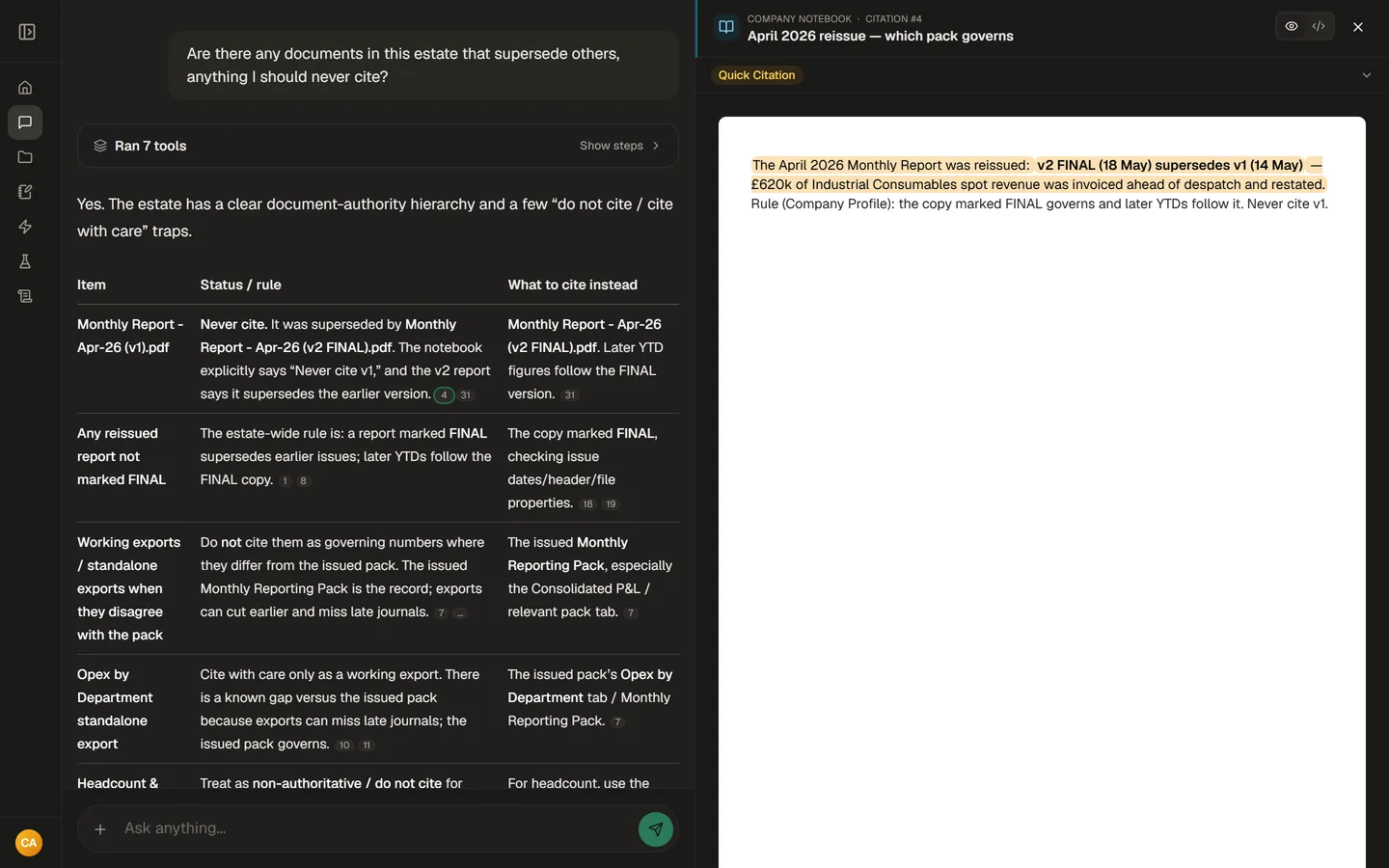
Both April packs open side by side on the Industrial Consumables line, v1 and v2, £620k apart. The version chip on the answer reads v2 FINAL.
The trust chain
The supersession rule is cited to the profile, the restated figure to both versions, and the difference sits in the calculator. Nothing on the strip is untraced.
What happens when you ask for an April number
Ask “What was April revenue?” and the answer comes from v2 and says so: version chip v2 FINAL (restated). Retrieval demotes the superseded document, so v1 isn’t the source even though it’s still in the estate. Ask for v1 by name and you get v1, labelled superseded.
What to notice
- The version is part of the answer. You don’t have to go and find it in a footnote.
- Superseded doesn’t mean deleted. The old copy stays for the audit trail and can be quoted on request, with its label.
- This is the thing a chat upload can’t do. It has no idea which of two files is the real one.
Video
Your AI doesn’t know which budget is real, the full film.
Related
Use cases: Check the board pack · Do these two reports agree? · The audit trail.
Posts: Introducing Grounded: AI that returns the version-correct number, with receipts · “Why not just upload it to ChatGPT?”.