
Who this is for, and the moment
The question that needs three files open and a calculator. A total that only exists once you’ve filtered a ledger extract down to the right rows and found the one line that moves it. Then the policy, to check whether that line was allowed in the first place. Nobody asks these on a Friday afternoon, because they cost an hour. They should cost a minute.
The question, as typed
“Per the May-26 GL extract, what is the total value of journal lines posted in June against period May-26, and which single item accounts for most of it?”
The answer
 Grounded
Per the May-26 GL extract, the journal lines posted in June against period May-26 total £333,173 Σ.
The single item accounting for most of it is JNL-508295, the £285,000 accrual for the Ridgway Freight May invoice received after ledger cut, posted on 2026-06-10 to Carrier & freight charges / Warehouse & Logistics. The other June-posted May-26 lines are much smaller: Digital media retainer, Advisory fees, and SaaS subscriptions. 59606162
£333,173 posted in June against May-26. One item dominates: the £285,000 Ridgway Freight accrual, posted 10 June by J. Whitfield to account 7120, Carrier & freight charges. The remainder is small routine trailing journals. Chips: GL Detail Extract, Opex, May-26, the four journal rows.
The citation clicked
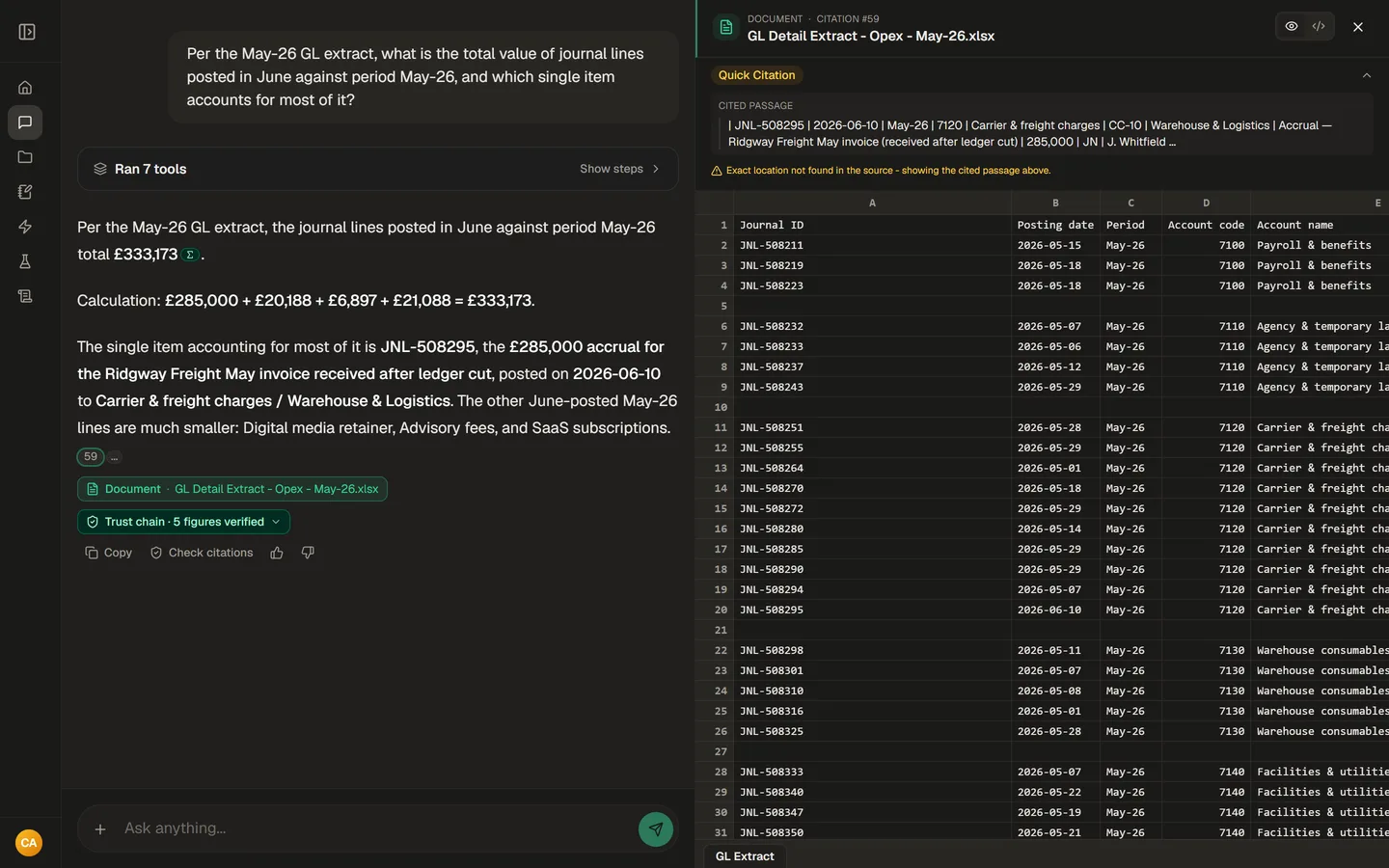
The extract opens on the journal row. Posting date, user, amount and account all sit on the row the answer quotes.
The trust chain
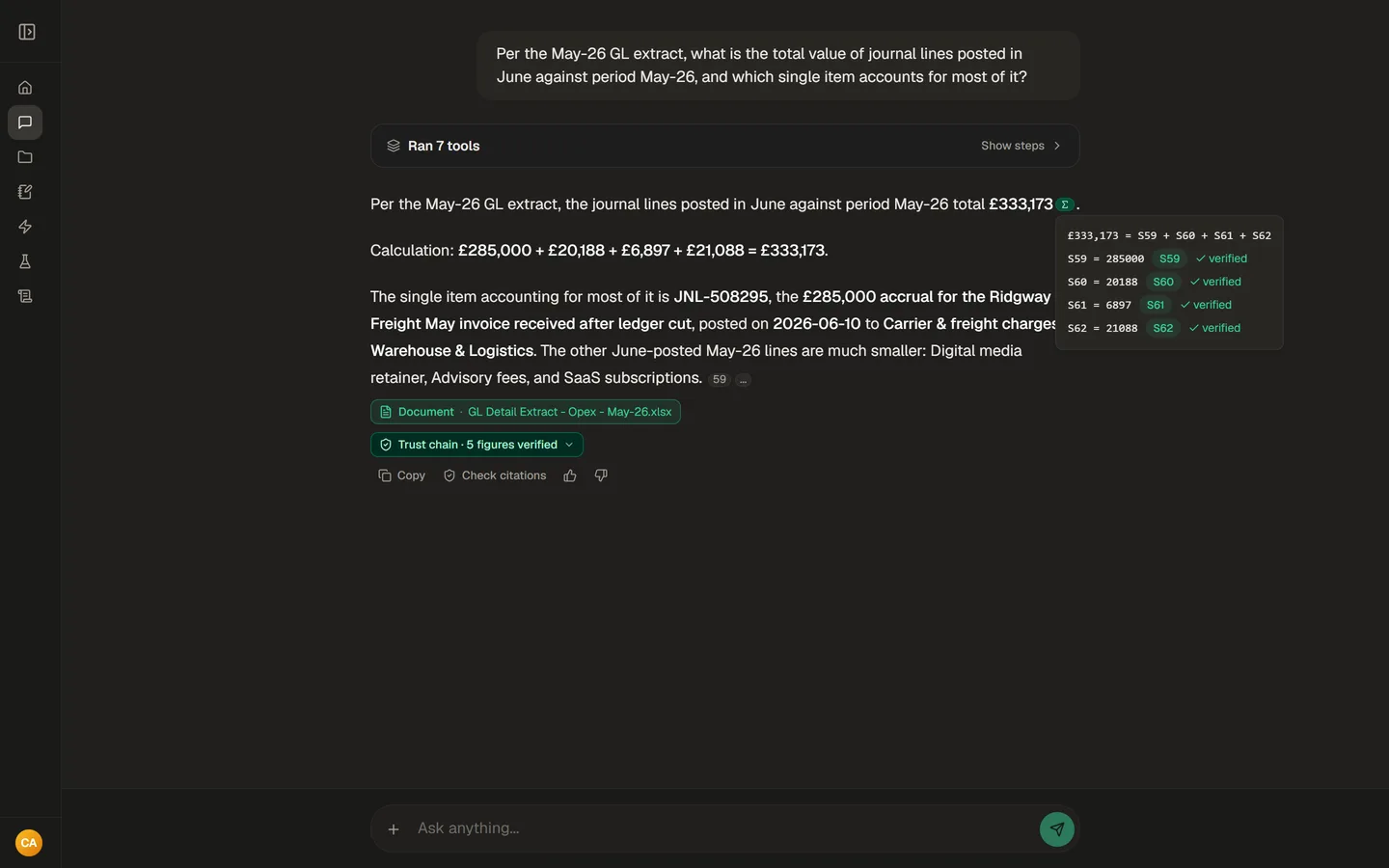
The strip states the filter first (posting month June, period May-26), then the sum in the calculator over the cited rows. The dominant item was found by comparing those rows, not by the model picking a number it liked. Every figure traced.
More of the same
- “Why does the Warehouse & Logistics export disagree with the pack on carriers?” Export £51k, pack £336k: the export was cut before the £285k accrual posted. The issued pack governs.
- “How did SSR’s FY25 cost recovery compare with its benchmarked peers?” 82.6%, between Northvale at 94.7% and Caldera Continental at 67.8%, consistent with a mixed network. Three documents.
- “Why doesn’t the GAAP net loss match the operating loss?” Operating loss $(306.0)M, net loss $(296.0)M, bridged by interest income, loan interest and tax, from the PDF reconciliation table. Not an error, and it says so.
What to notice
- The hard part is the filter and the join, and both are shown. You can redo the sum yourself.
- The policy document is read alongside the ledger. Whether a journal needed Financial Controller approval comes from the delegation of authority, with the threshold quoted from it rather than guessed.
- Deep mode exists for multi-document synthesis. It’s slower, and the answer says which documents it read.
Video
Why your AI can’t find your invoice: the three searches every document AI runs.
Related
Use cases: Easy queries · Do these two reports agree? · Run the close.
Posts: How an AI agent searches your files (and why Excel fights back).