
Who this is for, and the moment
The board asks something no report answers. What if the trial runs long? What does pausing a programme actually save? Half of any answer is fact and half is assumption, and most tools blend the two into one confident number. I built advisory mode to keep them apart, and to say which is which.
The question, as typed
“What is our cash runway, and what happens to it if the FANFARE-2 Phase 3 runs twelve months longer than planned?”
The answer
 Grounded
Recommendation: Use 37.7 months as the planning-case runway if FANFARE-2 / SFB-201 Phase 3 runs 12 months longer than planned.
Confidence: MEDIUM
As of the June 2026 close, Super Fancy Bio has $717.2M of cash, cash equivalents and investments, with $15.8M/month of YTD average net burn and 45.4 months of implied runway. 286 The schedule’s methodology assumes the YTD average burn continues and excludes the undrawn Stonebridge Capital facility. 287
For a 12-month FANFARE-2 extension, the best-supported planning case is an incremental $122.4M of CRO-related cash need: $5.9M/month of Tessern direct service fees plus $4.3M/month of pass-through costs, for 12 months. 162 That would consume about 7.7 months of runway at the current burn rate, reducing runway from 45.4 months to roughly 37.7 months. 286
I would also track sensitivities:
- Floor case: about 41.3 months of runway, assuming only recurring project/site costs continue. 155172
- Downside all-in program case: about 32.5 months, using recent FANFARE-2 program spend as a proxy. 308309310
The assumptions to challenge are: whether the 12-month delay should include only CRO direct/pass-through costs; whether CMC, internal FTE, lab, site, patient, and closeout costs are incremental; and whether the current YTD burn rate is the right denominator for runway planning.
The full advisory report is saved in the workspace as advisory-report.md. Happy to walk through the math, the sensitivity cases, or what management should request before approving an extension budget.
Facts, cited: cash $717.2M, average monthly burn $15.8M, runway 45.4 months, from the cash and runway schedule. The scenario driver comes from the CRO work order: $5.9M a month of direct service fees plus $4.3M of pass-through, $122.4M over twelve months. Assumptions, written down: the YTD average burn continues; the facility stays undrawn; the delay adds only the CRO costs. The answer lists the ones to challenge. Opinion, last and labelled: 37.7 months as the planning case, confidence medium, with a floor at 41.3 and a downside at 32.5. Chips: Cash & Runway Schedule · CRO Master Services Agreement and its amendment · Enrollment and Site Activation Report · R&D Spend by Program, three months.
The citation clicked
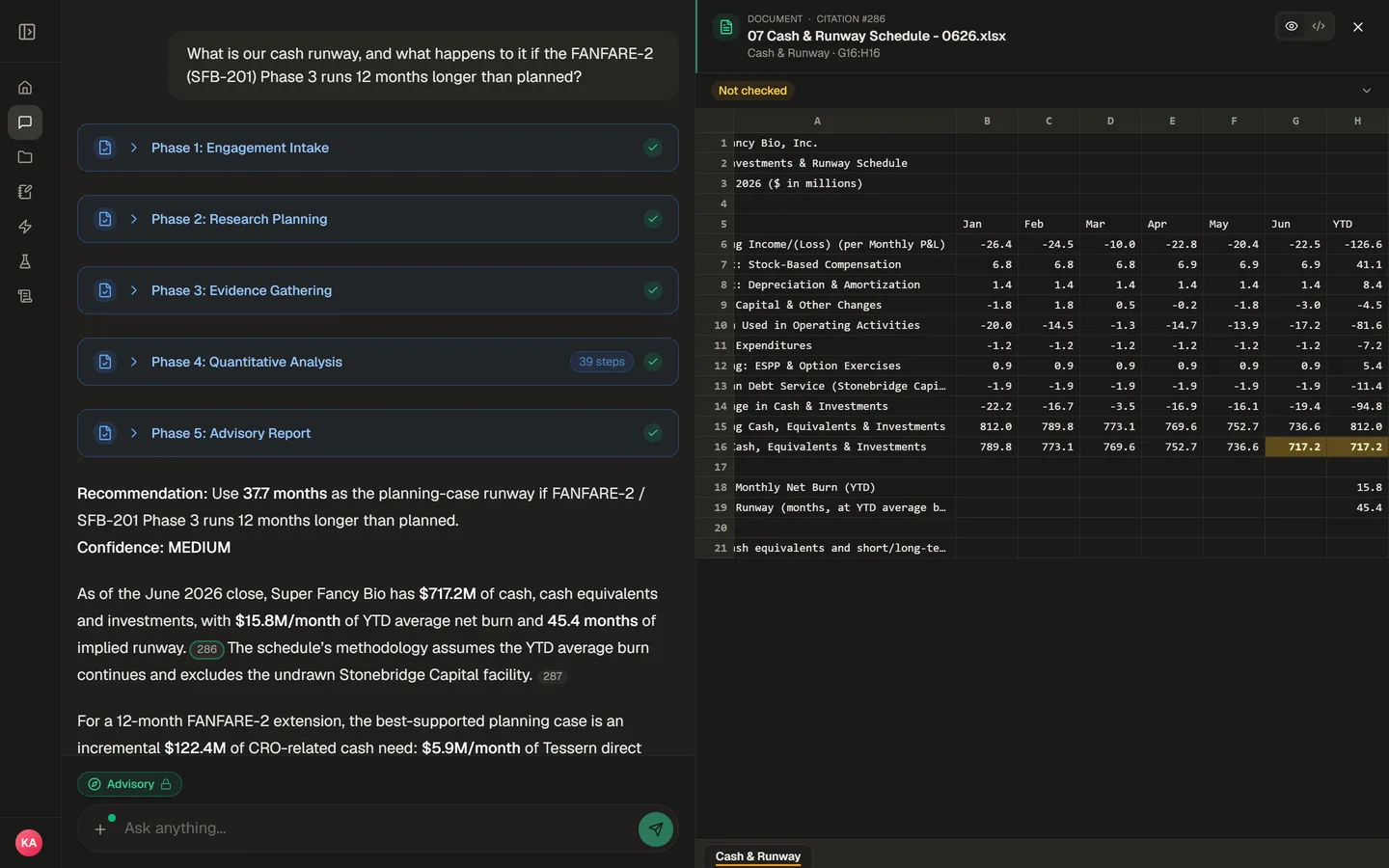
Click the first chip and the cash schedule opens on the ending cash row. The agreement chips open on the fee clauses the monthly figures came from.
The trust chain
An advisory run carries no guard strip under the answer. Its figures sit in the report with their citations, and each assumption is written beside the number it feeds, which is what makes the opinion checkable.
More of the same
- “How dependent are we on Swag, and what if demand fell ten percent?” Product revenue is $411.5M of $446.7M year to date, about 92%. The downside is computed over cited lines under a stated assumption.
- “What would adding 30 sites and 200 patients cost?” Site initiation 30 × $85k = $2.55M; site management on a twelve-month tail about $3.4M, tail stated; patient costs 200 × ($14.2k + $13.9k) = $5.62M; about $11.6M, about 0.7 months of runway. What it won’t say: whether enrolment speeds up. No site-productivity data exists, so that stays an open question in the answer.
- “Which programmes drive R&D burn, and what would pausing SFB-410 save?” Ranked programme spend, SFB-410 about $26.7M year to date, avoidable cost separated from allocated personnel and overhead, which doesn’t disappear when the programme does.
- “What will the board ask at the H1 review?” The four questions from the analyst note, cited as a note, not as document fact.
What to notice
- The three tiers never collapse into one. Facts are cited to cells, assumptions are written down, and the opinion is derived from those two and nothing else. A projected number gets its calculation shown and its assumption stated, every time.
- The honest refusal inside the answer: “the documents cannot separate this”. It names the missing data instead of inventing it.
- Advisory answers land in the audit trail with their assumptions on record.
Video
Watch one $2.1 million travel through an entire close (same corpus, the accrual that inflates the run-rate).
Related
Use cases: Check the board pack · The audit trail · Hard queries.
Posts: A runway question, answered with receipts · Citations aren’t verification.