
Who this is for, and the moment
Forty-two tests produce a long list. A roadmap needs five things, in order, each with a reason the next person can argue with. The ranking rules are written down, the ones that missed the bar are listed with why, and every card carries the test that found it and the check that says it is done.
The question
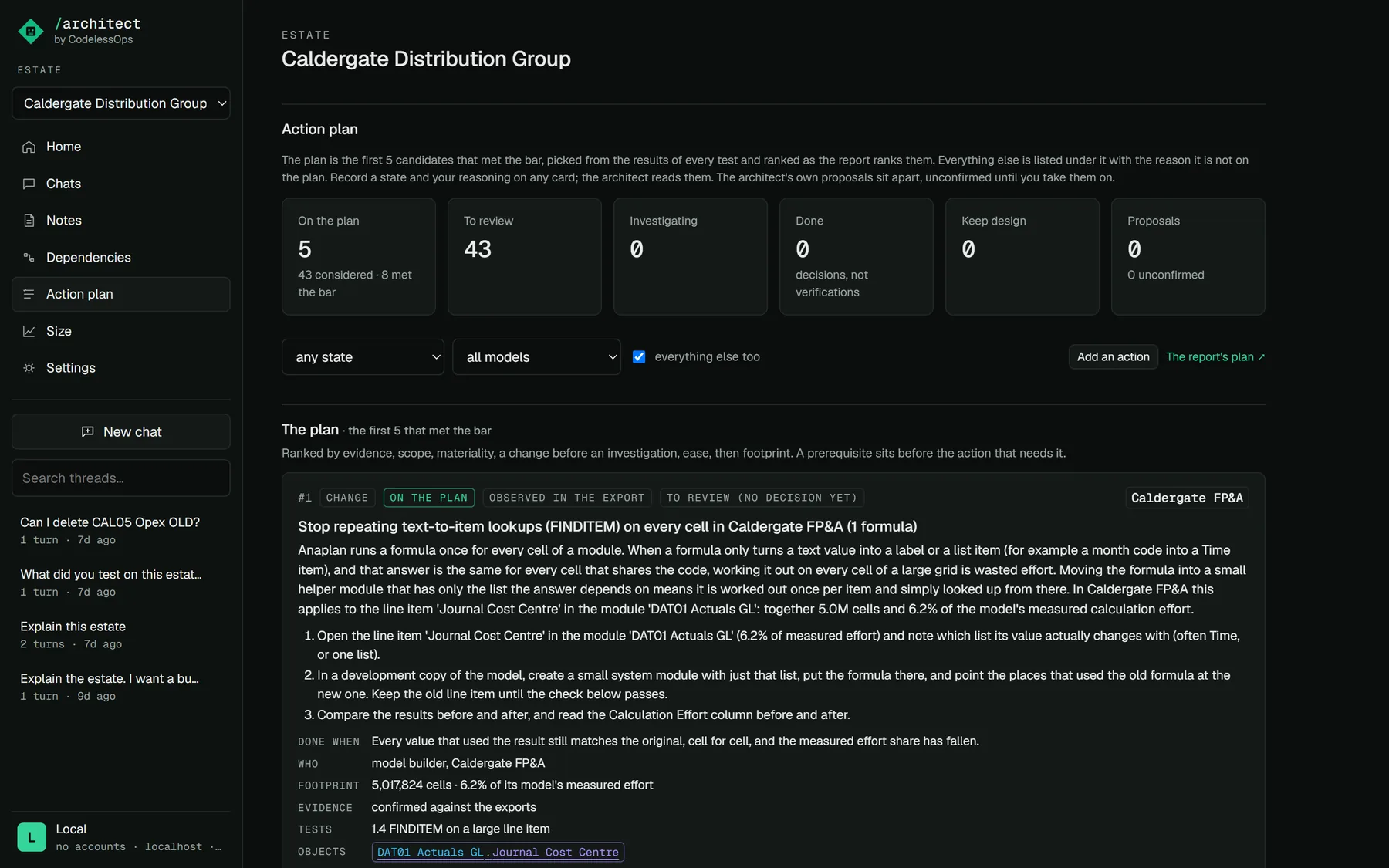
The action plan on the active snapshot, in the report’s order.
The result
Stop repeating text-to-item lookups (FINDITEM) on every cell in Caldergate FP&A (1 formula)
DAT01 Actuals GL.Journal Cost Centre · 5.0M cells · 6.2% of the model's effort · test 1.4
- Open the line item 'Journal Cost Centre' in the module 'DAT01 Actuals GL' (6.2% of measured effort) and note which list its value actually changes with (often Time, or one list).
- In a development copy of the model, create a small system module with just that list, put the formula there, and point the places that used the old formula at the new one. Keep the old line item until the check below passes.
- Compare the results before and after, and read the Calculation Effort column before and after.
Done when every value that used the result still matches the original, cell for cell, and the measured effort share has fallen.
Consider replacing the long chain of IF tests in the line item 'Forecast Opex' in the module 'CAL03 Opex' with a lookup table
CAL03 Opex.Forecast Opex · 5.0M cells · 16.0% of the model's effort · test 4.6
A long chain of 'if this then that' tests is hard to maintain: each new case means editing the formula, and the mapping is easier to check when it sits as rows in a small table read with one lookup. Whether the table also calculates faster depends on the engine and the formula (Anaplan documents that IF stops at the first true branch), so treat the performance side as something to measure, not assume.
Done when every cell is equal before and after, the table holds every case the chain held, and the measured effort is no worse.
Find out whether anyone still uses the module 'CAL05 Opex OLD' in Caldergate FP&A
CAL05 Opex OLD · 70.2M cells · 50.8% of the model's effort · test 2.1 · that is what it takes up now, not a saving
Find out whether anything reads these calculated line items in Caldergate FP&A (3 modules)
CAL03 Opex, DAT01 Actuals GL, CAL02 Revenue · 15.1M cells · 10.0% of the model's effort · test 2.3
Move per-cell text and lookups into small system modules in Caldergate Data Hub (2 line items)
DAT01 GL Transactions.Source System, DAT06 Sales Orders.Last Order Ref · 2.0M cells · materiality medium · tests 1.3 to 1.6
What "worth doing" means here
- A change is worth doing when its evidence is not merely inferred, its scope is bounded, and its materiality is at least medium (1% of its model's measured effort, or 1M cells, or a test that ranks high by nature, such as a total that may be wrong).
- An investigation is worth doing only when its materiality is high (5% of its model's measured effort, or 50M cells, or a test that ranks high by nature): asking someone to check a small module is not a good use of their time.
- A test about upkeep (naming, long formulas, hard-coded numbers, housekeeping of actions) never competes for the plan; its findings are listed below it and under Evidence.
Marking an action done records a decision. It does not verify anything in Anaplan. A proposal from the architect is a suggestion over the evidence it cites; it carries no state until the owner takes it on. 43 candidates: 43 to review, 0 investigating, 0 done, 0 kept as current design.
Evidence drawer · what each chip opens
- Line itemDAT01 Actuals GL.Journal Cost CentreLine Items export
- Line itemCAL03 Opex.Forecast OpexLine Items export
- ModuleCAL05 Opex OLDModules export
- Test1.4 FINDITEM on a large line itemfound
- Test4.6 Formulas with more than 10 IFsfound
Two changes first, with confirmed evidence and low or medium complexity. Then two investigations whose evidence is partial but whose materiality is high. Then a medium change in the data hub. Each card names its objects, its footprint in cells and share of the model’s effort, the test that found it, the steps, and what done looks like.
The evidence
Every card rests on findings from the tests, and every finding carries its strength: confirmed, partial or inferred. The ranking is deterministic and printed with the plan. Ties never depend on the order the files were read, so the same exports give the same plan every time.
What to notice
- An investigation outranks a change when the stakes are high enough. The 70-million-cell module is third, as an investigation, because the exports cannot see pages; the plan will not promise a saving it cannot verify.
- Marking a card done records a decision, with who and when. It does not verify anything in Anaplan. The app says so under the plan.
- The architect’s own proposals, from chat, sit apart from the deterministic cards and carry no state until the owner takes one on. Opinion never gets mixed into the evidence.
Related
Use cases: The 42 checks · Why it was built this way · Why the model is this size.
