1
The whole estate at a glance.
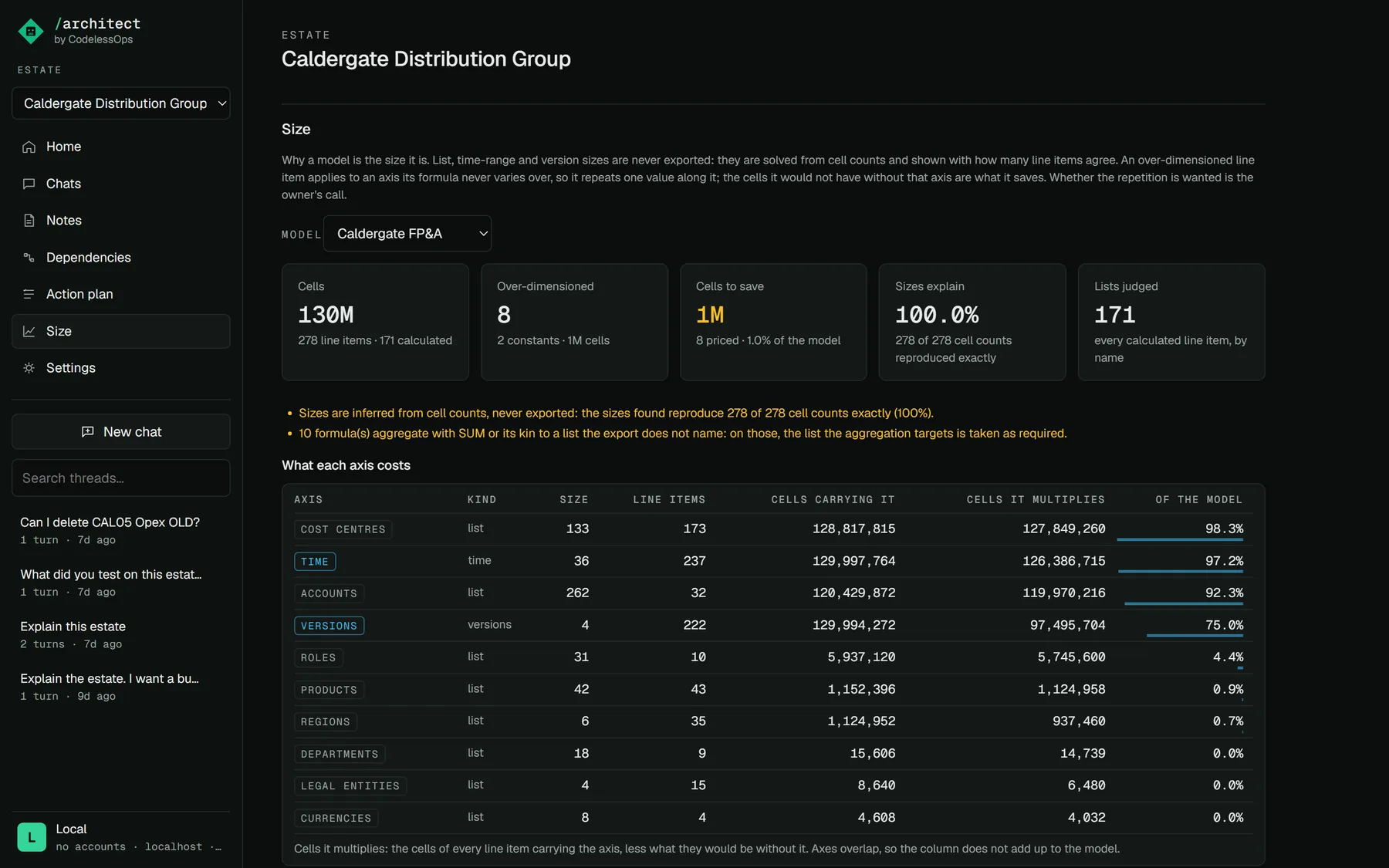
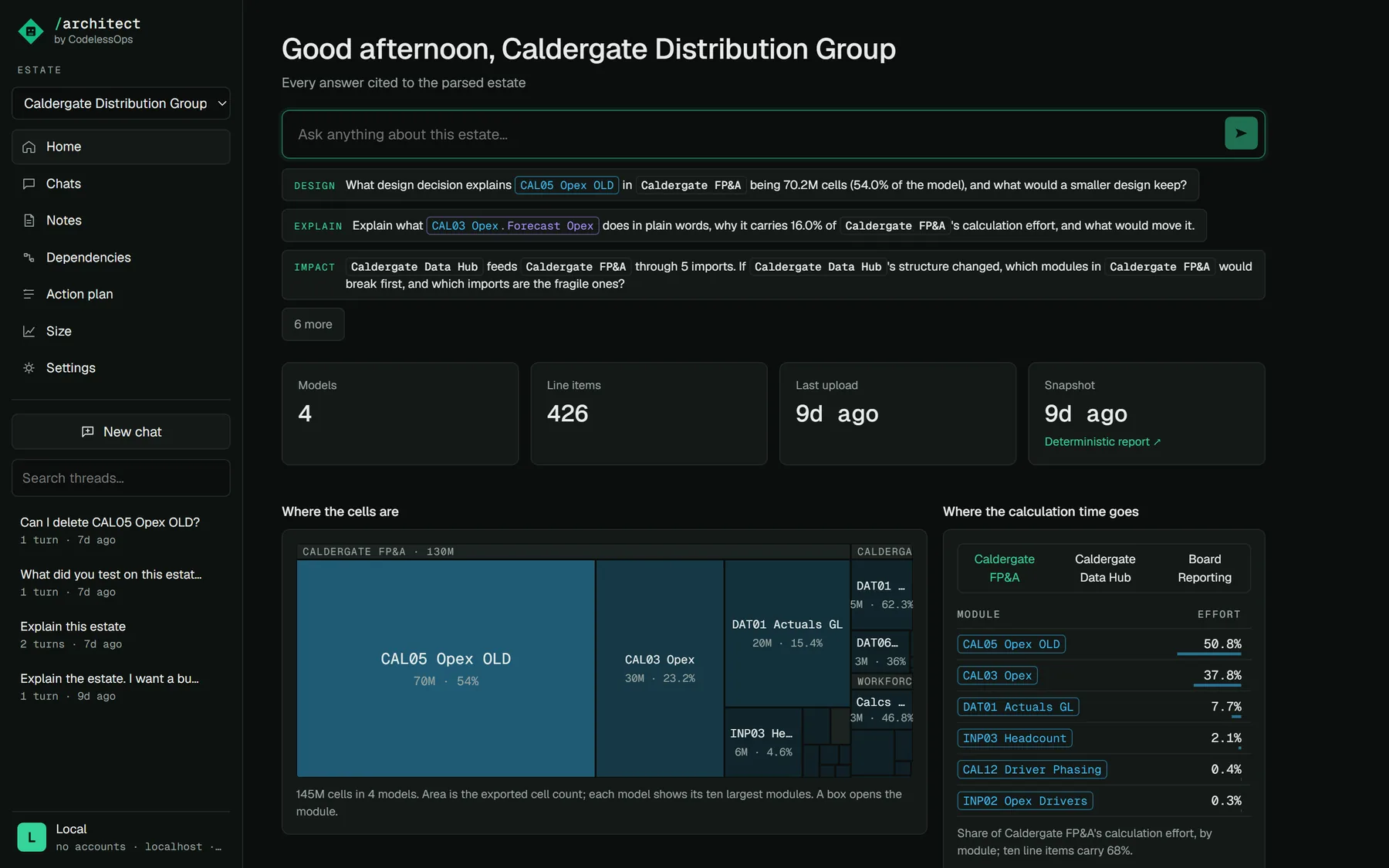
Which modules carry the estate, where the cells and the calculation time go, what feeds the board pack. The detail of any part when you want it. From the exports you already have, in minutes.

CodelessOps · Projects · Anaplan Architect
Not just the build, but the project and design documents, the meeting notes, even your own notes. Ask it questions as an assistant to you. If you inherited a complex implementation, that replaces trawling through notes and a massive list of line items wondering why they are there. It runs on your machine. It is by no means the finished article, and I am looking for a few people to take it to the finish line.
01 · Three things it does
1
Which modules carry the estate, where the cells and the calculation time go, what feeds the board pack. The detail of any part when you want it. From the exports you already have, in minutes.
2
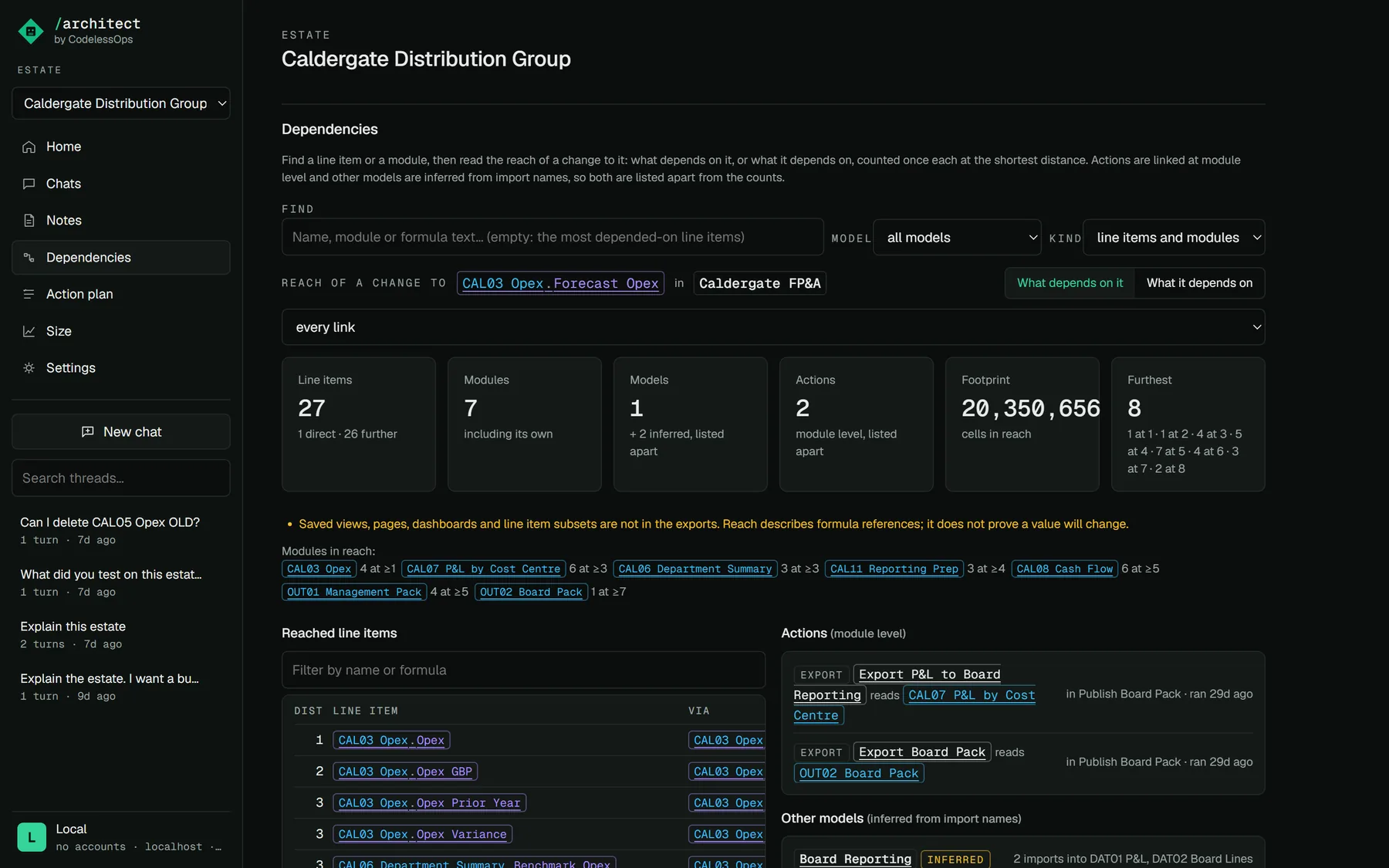
Pick a line item. See everything it reaches, across models, down to the actions that export it. Put the count in the change request.
3
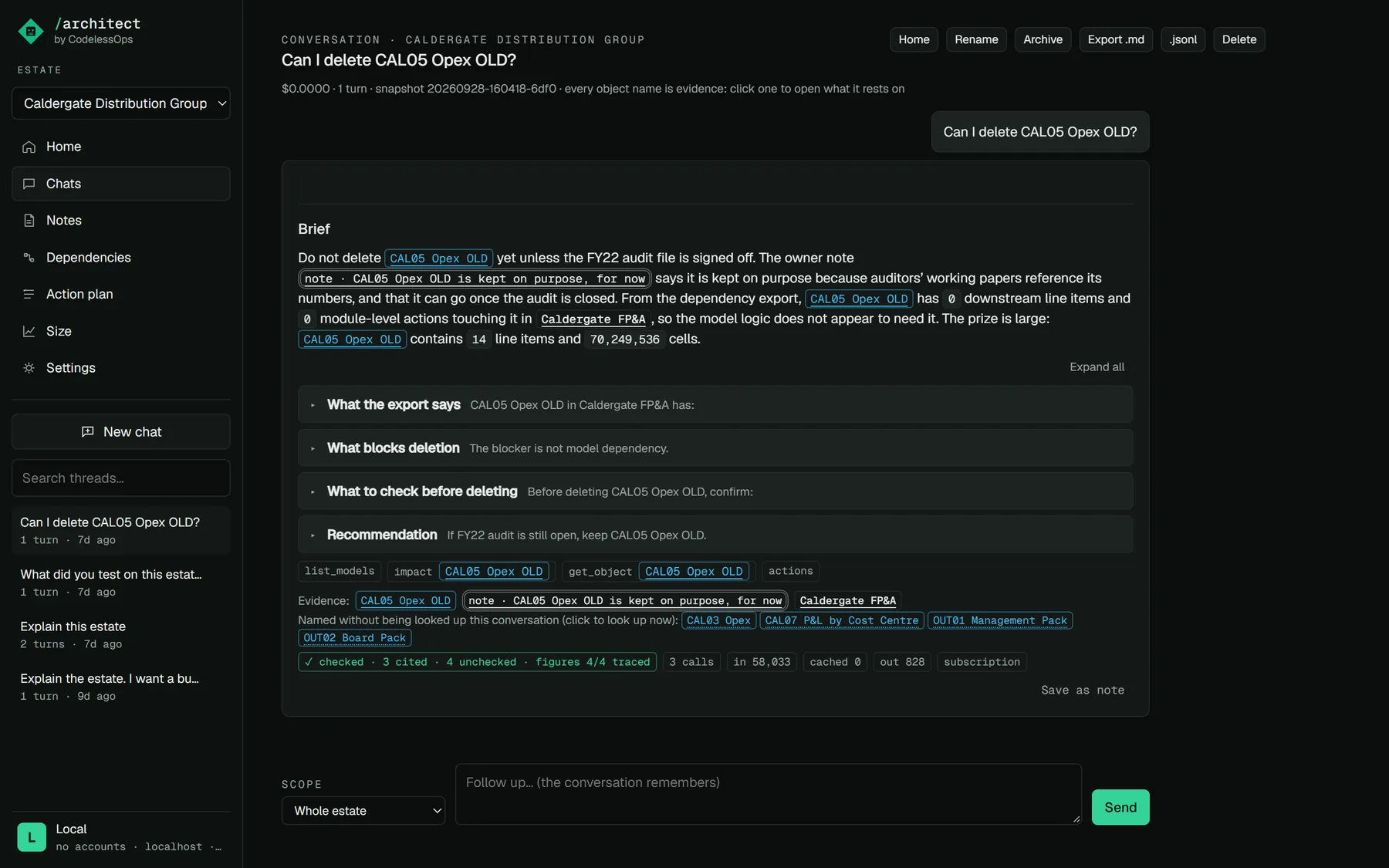
Ask it. It answers from the exports, the project and design documents, the meeting notes, your own notes, and the conversations before yours. Every answer shows its source. The documents side is built on Grounded, my finance document engine, and is being joined to the Architect now.
02 · From the architect's seat
Each line says where it stands. Built runs today on the exports.Next is built on Grounded and being joined to the Architect.Backlog is not built and needs a live estate to build against.
03 · Not finished
These need a read-only capture from the model itself and a live estate to build against. I do not have one of my own right now. That is the reason for this page: I would rather build them with the people who will use them than guess.
04 · Beside CoPlanner and CoModeler, not against them
CoPlanner answers a planner's questions. CoModeler helps a builder change a model. The Architect reads every model at once, changes nothing, and keeps the reasons. Use CoModeler to build; use this to understand, onboard and hand over.
| For | Where | Does | |
|---|---|---|---|
| Anaplan CoPlanner | Planners | Inside Anaplan, on loaded data | Answers questions about the plan, raises workflow tasks. |
| Anaplan CoModeler | Model builders | Inside the modelling experience, one model | Builds and changes a model from natural language. |
| Anaplan Architect | Whoever inherits the estate | Outside the platform, on your machine, every model | An architect who knows the estate: build, documents, notes. Never changes a model. Cites the source for every answer. |
05 · Got 20 minutes?
If you run Anaplan in-house, give me 20 minutes. I show it running on an example estate; you bring the three questions you would ask about yours. I built it on a very complex estate and it improved the confidence of my decisions and how fast I built. It is not the finished article, and I am not looking for a buyer. I am looking for a few people to take it to the finish line.
Built on anaplan-grammar andanaplan-estate, both open source. Part of my projects. Independent, not affiliated with or endorsed by Anaplan, Inc.; Anaplan is their trademark.
06 · Public record
Posts, walkthroughs and releases, each dated. Newest first.
07 · Questions
Twenty minutes. I show it running on an example estate and you bring the three questions you would ask about yours. If you want to go further, one anonymised line items export and 45 minutes on your own estate. No pitch, no licence afterwards.
No. It runs locally. The assistant sends retrieved rows to the model provider you choose with your own key; without a key the rest works and nothing is sent anywhere. Cell data is never read.
Upload the line items, modules and actions exports from Model Settings. A pull through the Anaplan API with a workspace administrator login is the next piece being wired in; the API says less about where a model-to-model import comes from than the export does, so the export stays primary.
The assistant does, over facts that come from code: the parser, the graph, the checks. Every sentence it writes points at one of those facts, and a sentence that does not is dropped. The graph, checks, diff, size and plan are deterministic and need no model at all.
The review is one report from one upload. The Architect keeps the estate: snapshots, notes, conversations, diffs between versions, and an assistant that cites its sources. The review is the first look; the Architect is what you live in.
There is no licence. A pilot is at my day rate and the tool stays with you. The grammar and the estate review underneath it are open source and free.
No. What the screenshots show runs today; the documents side is built and being joined. Saved views, pages and history are not, and I need real estates to build them against. I do not have a live implementation to work on right now, which is why this page asks for your time and not your budget.