Who this is for, and the moment
The module with OLD in its name, 70 million cells, half the model’s calculation time. Everyone wants it gone. Nobody will sign the deletion, because nobody is sure what reads it outside the model. That uncertainty is usually one sentence long, and somebody once knew it.
The question, as typed
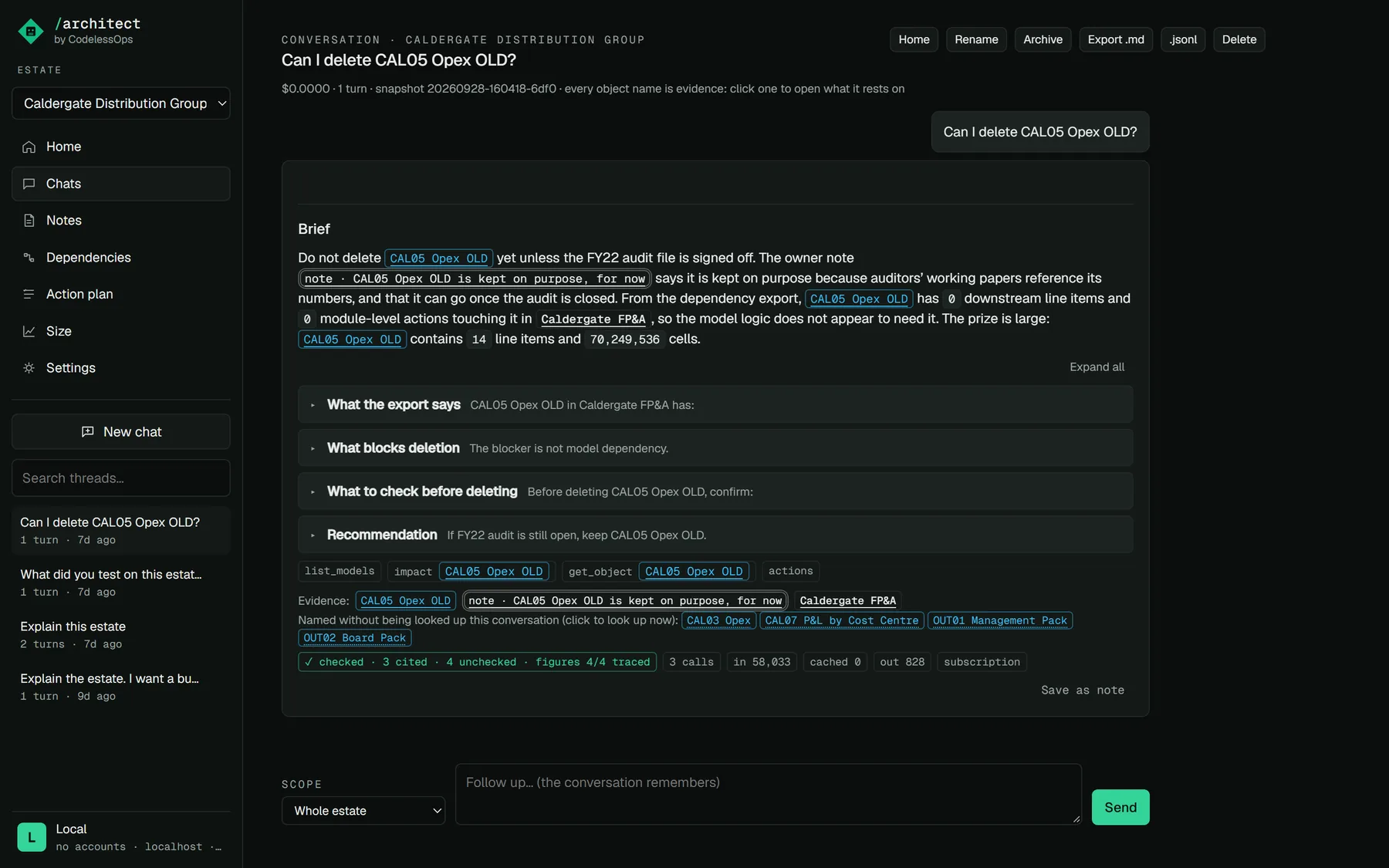
“Can I delete CAL05 Opex OLD?”
The answer
Brief
Do not delete CAL05 Opex OLD yet unless the FY22 audit file is signed off. The owner note n-e6ddcfdc13 says it is kept on purpose because auditors’ working papers reference its numbers, and that it can go once the audit is closed. From the dependency export, CAL05 Opex OLD has 0 downstream line items and 0 module-level actions touching it in Caldergate FP&A, so the model logic does not appear to need it. The prize is large: CAL05 Opex OLD contains 14 line items and 70,249,536 cells.
What the export says
| Check | Result |
|---|---|
| Line items in module | 14 |
| Cells in module | 70,249,536 |
| Downstream line items | 0 |
| Direct downstream line items | 0 |
| Indirect downstream line items | 0 |
| Actions touching the module | 0 |
The module note also says: “Replaced by CAL03 in 2021. Keep until the FY22 audit is closed.”
What blocks deletion
The blocker is not model dependency. It is audit evidence.
Owner note n-e6ddcfdc13 says CAL05 Opex OLD was replaced by CAL03 Opex in 2021, but is kept until the FY22 audit file is closed because auditors’ working papers reference its numbers. That note also says nothing reads it, and once the audit is signed off it can go.
What to check before deleting
- FY22 audit file is signed off.
- Nobody still needs the old module for audit queries.
- Any saved views, UX pages or dashboards that might show
CAL05 Opex OLDhave been checked manually. These are not in the exports. - Delete it first in a development copy of
Caldergate FP&A.
Recommendation
If FY22 audit is still open, keep CAL05 Opex OLD.
If FY22 audit is signed off, delete CAL05 Opex OLD in a development copy, regression check CAL03 Opex, CAL07 P&L by Cost Centre, OUT01 Management Pack and OUT02 Board Pack, then promote the change.
Named without being looked up this conversation: CAL03 Opex, CAL07 P&L by Cost Centre, OUT01 Management Pack, OUT02 Board Pack.
Evidence drawer · what each chip opens
- ModuleCAL05 Opex OLDimpactobserved
- Owner noteCAL05 Opex OLD is kept on purpose, for nownotesuser confirmed
- ModelCaldergate FP&Alist_modelsobserved
No, not yet. The exports say nothing reads it: zero downstream line items, zero actions. The owner note says the auditors’ working papers still reference its numbers and it goes when the FY22 audit file closes. The answer puts both in front of you, names the four modules to regression-check afterwards, and says which of those it did not look up.
The evidence
Three citations: the module, handed by the impact tool with its zero reach; the owner note, confirmed by the owner; the model. Four figures in the answer, four traced to a tool result. Four module names were written without being looked up, and the app lists them under the answer so you can open any of them now.
What to notice
- The blocker is not model dependency, it is audit evidence. No test could have found that. The note did, and the answer leads with it.
- The deletion path is in the answer: development copy first, regression check the named modules, then promote. The reviewer gets a plan, not a verdict.
- Nothing is marked checked that was not. The verdict line under the answer is the app’s own: every name was handed by a tool or is in the estate, every figure traces, and the four unchecked names are listed.
Related
Use cases: What nothing reads · The reach of a change · Why it was built this way.